
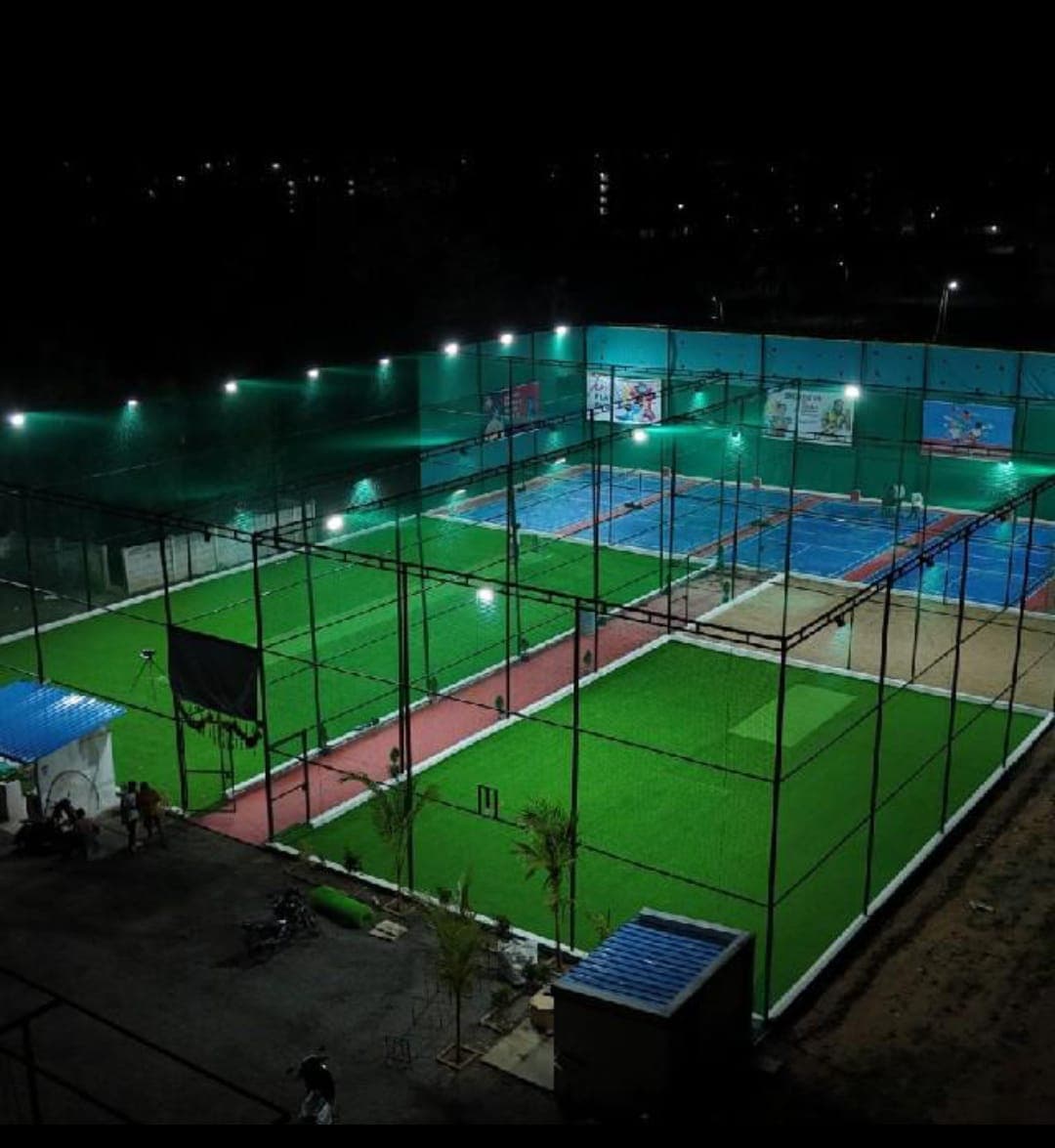
Cricket Practice Nets
Side and overhead netting for batting and bowling practice at home or school.
Premium Invisible Grills & Safety Nets across South & West India.
Service
Sports netting is engineered around repeated impact rather than static load, which makes it a different discipline from safety netting even though the raw material looks similar. A cricket ball leaving a bat carries enough energy to punch through a net that would comfortably hold a person, and the failure is rarely in the mesh: it is at the point where a slack net has been allowed to snap against a steel post. Post spacing, cable support and tension are therefore as much a part of the specification as the net itself.

overview
Sports netting is engineered around repeated impact rather than static load, which makes it a different discipline from safety netting even though the raw material looks similar. A cricket ball leaving a bat carries enough energy to punch through a net that would comfortably hold a person, and the failure is rarely in the mesh: it is at the point where a slack net has been allowed to snap against a steel post. Post spacing, cable support and tension are therefore as much a part of the specification as the net itself.
Contains balls within a playing or practice area so surrounding property, vehicles and passers-by are not struck.
benefits
features
applications
materials
| Material | Specification | Why it matters |
|---|---|---|
| Braided nylon netting | Nylon 6, braided, 1.5 mm to 3 mm twine, knotted | Nylon's elasticity lets it absorb ball impact and recover, which is why it outlasts stiffer polymers in practice nets. |
| HDPE sports netting | UV-stabilised HDPE, 2 mm to 4 mm twine | More rigid and cheaper than nylon, and a sound choice for perimeter barrier duty where direct high-speed impact is rarer. |
| Support structure | Hot-dip galvanised MS posts with catenary cable and turnbuckles | Galvanising is essential on posts set into ground that stays wet, since corrosion at the base is the usual mode of failure. |
installation
This is survey-led work. A typical job takes 8 to 40 hours on site once the specification is settled.
Site and sport assessment
We establish the sport, playing level and boundary conditions, which together set net height, aperture and post grid.
Foundations and post erection
Posts are set in concrete foundations sized for wind load and net tension, then left to cure before any net is hung.
Cable rigging
Top and intermediate cables are strung and tensioned to form the frame the netting will hang from.
Net hanging and lacing
Panels are hung, laced to cables and to each other so there is no gap at seams, then tensioned evenly.
Impact and gap testing
The installation is checked for ball escape routes at ground level, seams and corners before it is signed off.
safety
maintenance
We recommend an inspection every 6 months. Most of it is straightforward enough to do yourself.
quality
This product carries a 2-year warranty on materials and workmanship, on the basis that the recommended inspection is carried out.
pricingFactors
We do not publish a rate per square foot, because the same area can differ in price by a factor of two depending on grade, spacing and access. Every quotation states these explicitly.
Planned around your opening
A balcony, a window and a utility opening each need a different sports nets approach. We consider how you use the space, where the fitting can be secured, and how you will access it afterwards.
Play without collateral damage
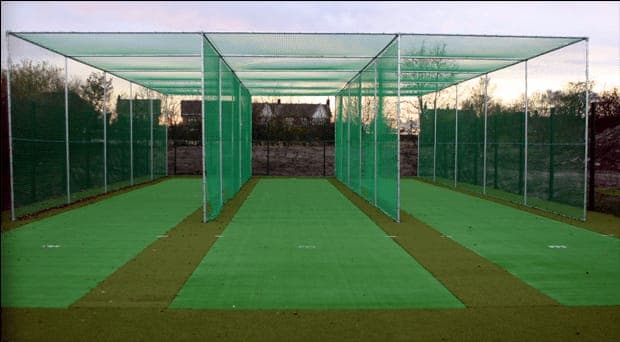
Containment lets a ground operate next to parked cars and glazing without the constant risk of a broken windscreen or window.
More usable ground per square metre
Netting divides a site into lanes or courts, so one footprint can host several simultaneous sessions.
Built for repeated impact
Correct twine and tension mean the net absorbs and returns a ball for years instead of blowing out in a season.
More ways to make your space work
Start with the job the opening needs to do. Each page keeps its own specification notes — not a copied national paragraph.
Side and overhead netting for batting and bowling practice at home or school.
Side and overhead netting for batting and bowling practice at home or school.
Impact-rated barrier and containment netting for cricket practice, turf grounds, terraces and multi-sport courts.
Side and overhead netting for batting and bowling practice at home or school.
Side and overhead netting for batting and bowling practice at home or school.
Side and overhead netting for batting and bowling practice at home or school.
01
Send a clear photo, your city, and whether the priority is children, pets, birds, visibility, or sports use.
02
We confirm dimensions, fixing surfaces, access, and how the space is used day to day.
03
Review material grade, spacing, included installation, warranty terms, and the price unit in writing.
04
Fit the chosen system, check edges and tension, and walk through basic care before handover.
Our work
Installation photography from comparable openings — used to judge finish quality before you book a survey.
Service areas
Pick your city for climate-specific notes and local installation guidance — not one metro paragraph reused nationwide.
Each link is its own hub page with unique content, then the same state ladder.
Photo → WhatsApp estimate
One wide shot and a close-up of the fixing surface are enough to confirm coverage, suggest the right system, and outline what should appear on a written quotation before you book a survey. Firm totals still follow measurement on site.
It depends on the standard of play and how close the boundary is to whatever you are protecting. A practice lane needs less height than an open box-cricket ground with a road behind it. We size height from the expected ball speed and the distance to the nearest thing that can be damaged, rather than from a standard figure.
We deliberately do not, because a single rate would be misleading. The same area costs very different amounts depending on the grade of hardware, the spacing you need, the height you are working at and the condition of the substrate. Our pricing guide sets out every factor that moves the number so you can see how a quotation is built up.
We cover the localities listed on our service area pages, and those lists reflect where we genuinely operate rather than everywhere we would like to. If your locality is not listed, call us anyway: we often work just beyond a listed boundary, and we will tell you plainly if a job is outside our reach rather than sending someone unprepared.
Warranty depends on the product, and the figure for each one is stated on its service page rather than promised generically here. In every case the warranty covers materials and workmanship on what we installed, and it assumes the yearly inspection is carried out. We will always tell you what is and is not covered before you commit.
A properly stabilised net in a moderate climate should give several years of service, and considerably longer where it is shaded. The way to judge it is by feel rather than by date: twine that has become stiff or chalky and snaps instead of stretching has reached the end of its life and should be replaced.
Once a year is right for most installations, and it is largely something you can do yourself: press the cables or net at mid-span to feel for slack, look at the anchor points for rust weeping or hairline cracking, and wash the surfaces down. In coastal and cyclone-exposed locations we recommend an additional check after the wet season.
A cloth hanger is usually done in an hour or two. A single balcony safety net takes two to six hours, and an invisible grill on one or two bays takes most of a working day. Larger jobs such as sports enclosures or building covering run to several days because foundations and scaffold have to be dealt with first.
In most gated communities and housing societies, yes, because anything fixed to an external wall or balcony counts as a facade alteration. We can supply the drawings and material specification you need to submit. It is worth starting that process early, since approval usually takes longer than the installation itself.
Sometimes. Moving from 316 to 304 stainless is a genuine saving and perfectly sound at an inland address, and a coarser mesh is fine if you only need to keep birds out. What we will not do is reduce cable spacing tolerance or anchor quality, because those are the two things that decide whether the installation actually holds.
If the ground is hemmed in by buildings or a road, usually yes, because a lofted ball leaves over the top rather than through the side. Adding a roof changes the structural problem rather than just the area, since the posts and cables then carry a much larger wind load, so it is designed rather than simply extended.
It needs attention but rarely means replacement. Slack in a cable widens the gap under load, which is the thing a barrier exists to prevent, and slack in a net lets it whip and abrade against fixings. Both are usually corrected by re-tensioning at the existing hardware, which is a short visit rather than a new installation.
For anything structural we do, yes. We can give an indicative range over the phone from your balcony dimensions, but the final price depends on the condition of the wall or slab we are fixing into, the access route for materials, and the exact spacing you need. A survey takes about twenty minutes and means the quotation we give you is the price you pay.
Photo estimate
Share your city and a clear photo of the opening. We reply with the right system options and what a written quote should include.
Explore more
Continue this service, compare nearby locations, or open a buyer guide — every cluster is unique to this page.
1 sections
2 sections
1 sections
1 sections
1 sections
Conversion
Send a photo, book a callback, or call the team — we reply with the right system options for your opening.